
How Static Mixers Work
Overview
Static mixers are installed in the flowline near the wellhead. They are installed in a slipstream configuration if treating downhole or directly in the flowline if treating as the surface level.
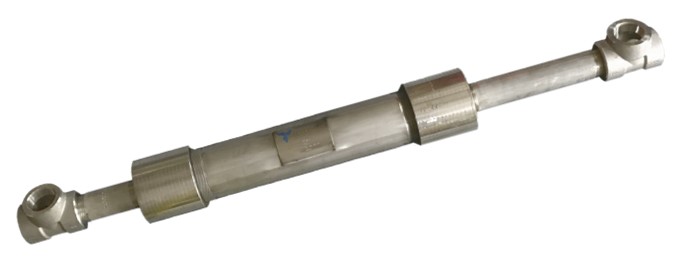
A Tellerus static mixer consists of a stainless steel body either 2″, 4″ or 6″ in diameter, depending on the application and flowrates. The stainless steel body contains motionless elements which work to redistribute fluid in directions transverse to the fluid flow (i.e. in the radial and tangential directions).
Mixing
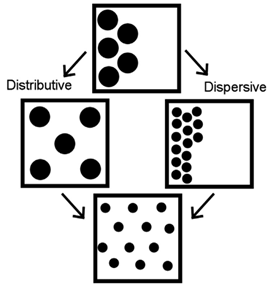
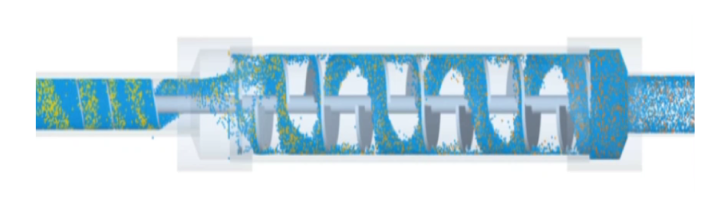
Fluid streams are rotated, twisted and stretched by the elements as the fluid flows through the static mixer. Static mixers achieve both dispersive and distributive mixing.
Shear and elongational stresses break apart chemical droplets into even smaller droplets. This is called dispersive mixing.
The small droplets are distributed at an even concentrations throughout the cross-section. This is known as distributive mixing. This limits the cohesive forces bringing the small, dispersed droplets back into larger droplets again.
Chemical Action
The smaller chemical droplets increase the surface area of the chemical. This allows for greater contact between the chemical and the surface being treated. This increases the desired chemical reaction and mass transfer per gallon of chemical injected.
Both dispersive mixing (represented by color changes from Upstream to downstream ends) and distributive (spatial) mixing
Chemical Drop Size
Original Size
(Starts journey through static mixer)

partially reduced size
(Part way through static mixer)

fully reduced size
(All downstream end of static mixer)